
Meriden Criminal Court Cases
Connecticut abolished county government, so there is no county criminal clerk for Meriden. Local cases generally begin in the Connecticut Superior Court system at Geographical Area 7, commonly called GA 7. The courthouse sits at 54 West Main Street in Meriden. GA locations primarily handle arraignments, misdemeanors, motor-vehicle cases, and many class C, D, and E felonies. More serious matters, mostly class A and B felonies, may proceed through New Haven Judicial District Part A.
The Superior Court clerk keeps the judicial file. Meriden Police keeps the incident or arrest report that preceded it. Those records can differ because prosecutors decide what charges to file, reduce, add, or decline. Connecticut has no separate Meriden municipal criminal court. A city citation, police arrest, or station booking therefore does not create a city-court docket.
Meriden's Two Record Counters
Two adjacent downtown offices answer different questions. The Meriden Police Records Division at 50 West Main Street supplies police-created reports. GA 7 at 54 West Main supplies docket entries and court-file documents. Ask MPD what officers documented. Ask the clerk what was filed, heard, and decided.
Superior Court GA 7
54 West Main Street
Meriden, CT 06451
203-238-6130
New Haven Part A
235 Church Street
New Haven, CT 06510
203-503-6800
A case may start at GA 7 and later appear under New Haven. Search beyond the Meriden location when the local query is empty or the docket shows a transfer.
Searching Meriden Case Records
The Judicial Branch criminal and motor-vehicle gateway separates pending cases, convictions, daily dockets, and docket-number searches. It is not one universal index. Use the pending defendant search for active matters and the conviction search for a completed guilty disposition. A docket number is the cleaner key when available.
- Choose pending cases, convictions, or the daily docket based on the question.
- Enter the last name and add a first initial or birth year to reduce false matches.
- Select Meriden Geographical Area 7, but repeat the search under New Haven Judicial District if the case may have moved.
- Open the result and save its docket number, court location, case status, and accuracy timestamp.
- Contact the clerk for a certified copy, an archived file, or a public document absent from the portal.
| Field | Type | Required | Portal note |
|---|---|---|---|
| Last Name | Text, begins with | Yes | Up to 60 characters |
| First Initial | Text | No | One character |
| Birth Year | Number | No | Four digits |
| Year Range | Number | No | Plus or minus one-digit range |
| Court Location | Dropdown | No | GA 7 uses code N07M |
| Category | Dropdown | No | Criminal, motor vehicle, or referral category |
Meriden Portal Gaps
A blank online result is not proof that no court record exists. The conviction index generally keeps entries online no longer than ten years after sentencing. Practice Book retention rules can remove them sooner, and the online entry may disappear about a month before its retention period ends. Youthful Offender matters, juvenile cases, infractions, violations, erased records, and some forfeiture matters do not appear.
Names also change, cases move, and corrections occur daily. Check spelling, aliases, birth year, the docket prefix, and both GA 7 and New Haven. Then call the clerk. Ask whether the file is archived, restricted, erased, or available only at the courthouse. Portal output is a convenience view unless the Judicial Branch identifies it as certified.
The pending defendant search shows an as-of timestamp. Save it with the docket number when asking about an error.
Inside a Meriden Case File
A public criminal file tracks the judicial action, not every allegation in a police narrative. The most useful fields identify the court, the charges actually filed, each event, and the final result. Financial details appear only when the particular public view exposes them.
| Docket number and court | The unique case key, location code, and assigned Superior Court venue. |
|---|---|
| Charging document | The offenses prosecutors placed before the court, which may differ from arrest charges. |
| Docket entries | Chronological filings, appearances, continuances, motions, and rulings. |
| Hearing dates | Scheduled and completed court events, subject to later change. |
| Disposition | How each count ended, such as conviction, dismissal, acquittal, or nolle. |
| Sentence | Confinement, probation, fines, restitution, or other court-ordered terms when public. |
The convictions-by-defendant index is useful for guilty outcomes. Compare each count rather than treating the case as one result.
Reading Connecticut Dispositions
Connecticut docket terms can alter what a search result means. A nolle is not a conviction. It means the prosecutor declined to continue the charge at that point. Under Connecticut law, a nolle ordinarily becomes eligible for erasure after thirteen months.
- Arraignment
- The first court appearance at which the accused is advised of charges and release terms are addressed.
- Disposition
- The outcome recorded for a charge, not merely the status of the case as a whole.
- Nolle
- A decision not to prosecute at that time, commonly followed by statutory erasure after the waiting period.
- Dismissal
- A charge ended without a conviction.
- Mittimus
- The court order that commits a person to correctional custody.
Read the outcome beside the correct count and date. An old arrest label should not be substituted for the court's later disposition.
How a Criminal Case Moves
After police action, prosecutors review the report and decide what to file. The court then creates the docket. Release conditions and counsel may be addressed at arraignment. Pretrial dates allow motions, evidence review, negotiation, and scheduling. A plea or trial produces the disposition, followed by sentencing when guilt is established.
Case flow: Charges Filed › Arraignment › Pretrial › Plea or Trial › Disposition › Sentencing
The flow can branch. Counts may be substituted or dismissed, a case can transfer to New Haven, and an appeal creates a separate appellate record. Dates in the portal are schedules, not promises that an event occurred as first listed.
Official Meriden Court Sources
The Judicial Branch case gateway leads to the approved criminal searches.
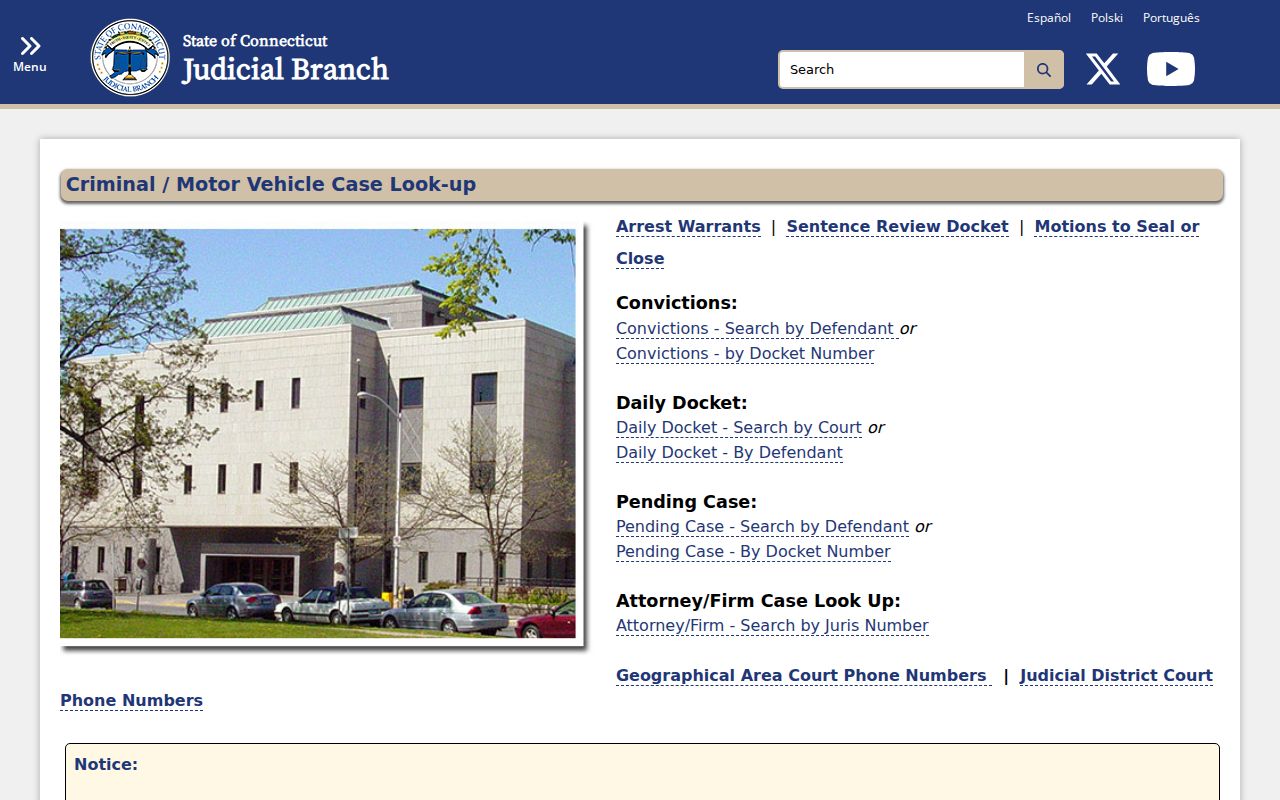
Its separate tools keep pending and disposed Meriden records from being confused.
The pending-case form shows the defendant fields and location filter.
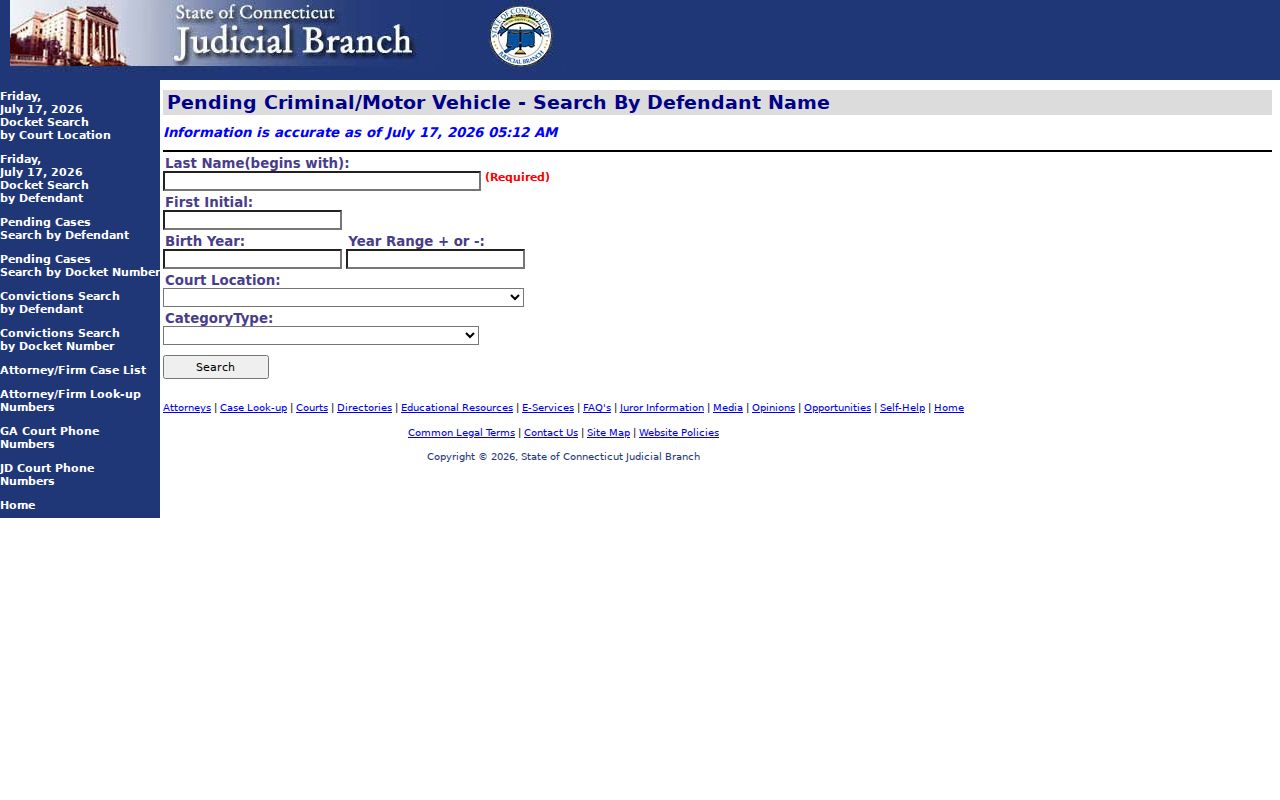
Birth year and court location help distinguish people with similar names.
The GA 7 directory identifies Meriden's local criminal courthouse.
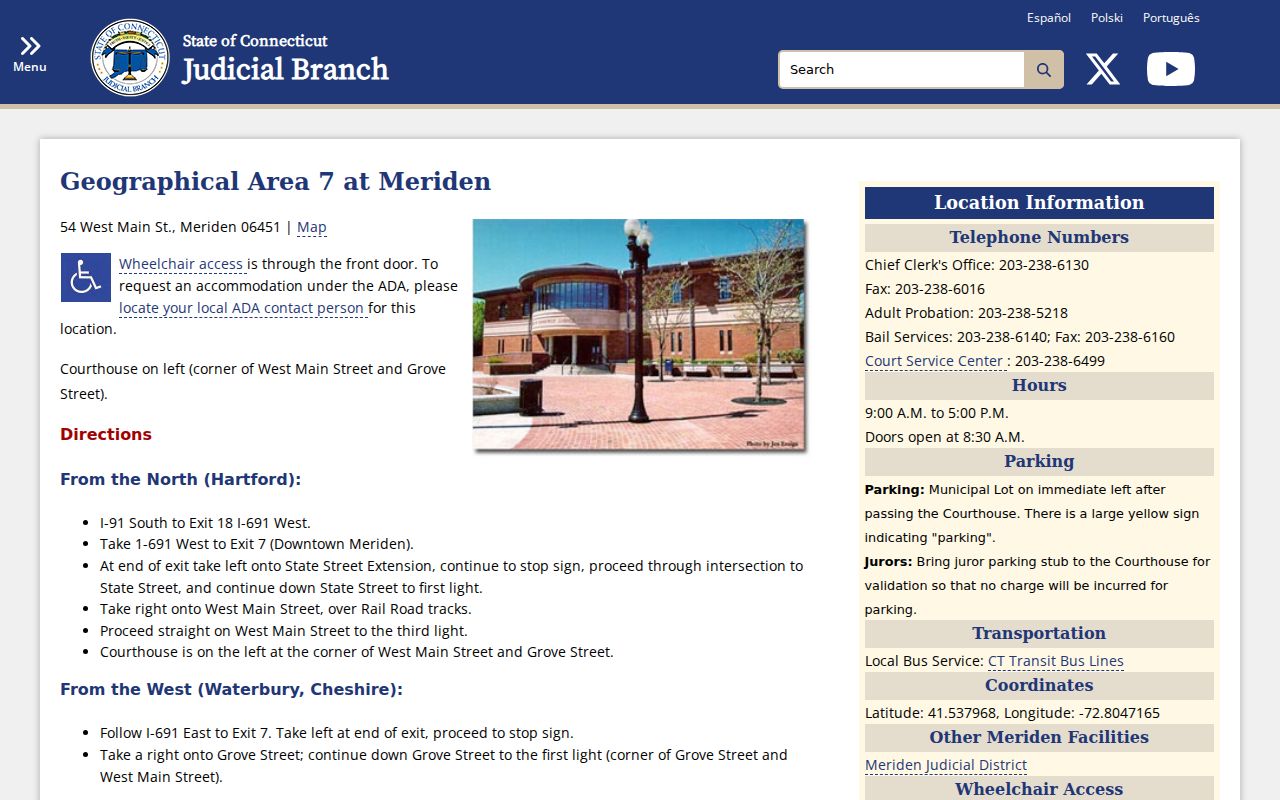
The clerk remains the fallback when an online case is incomplete.
Convictions and Erased Records
The official conviction search is designed for disposed guilty matters.
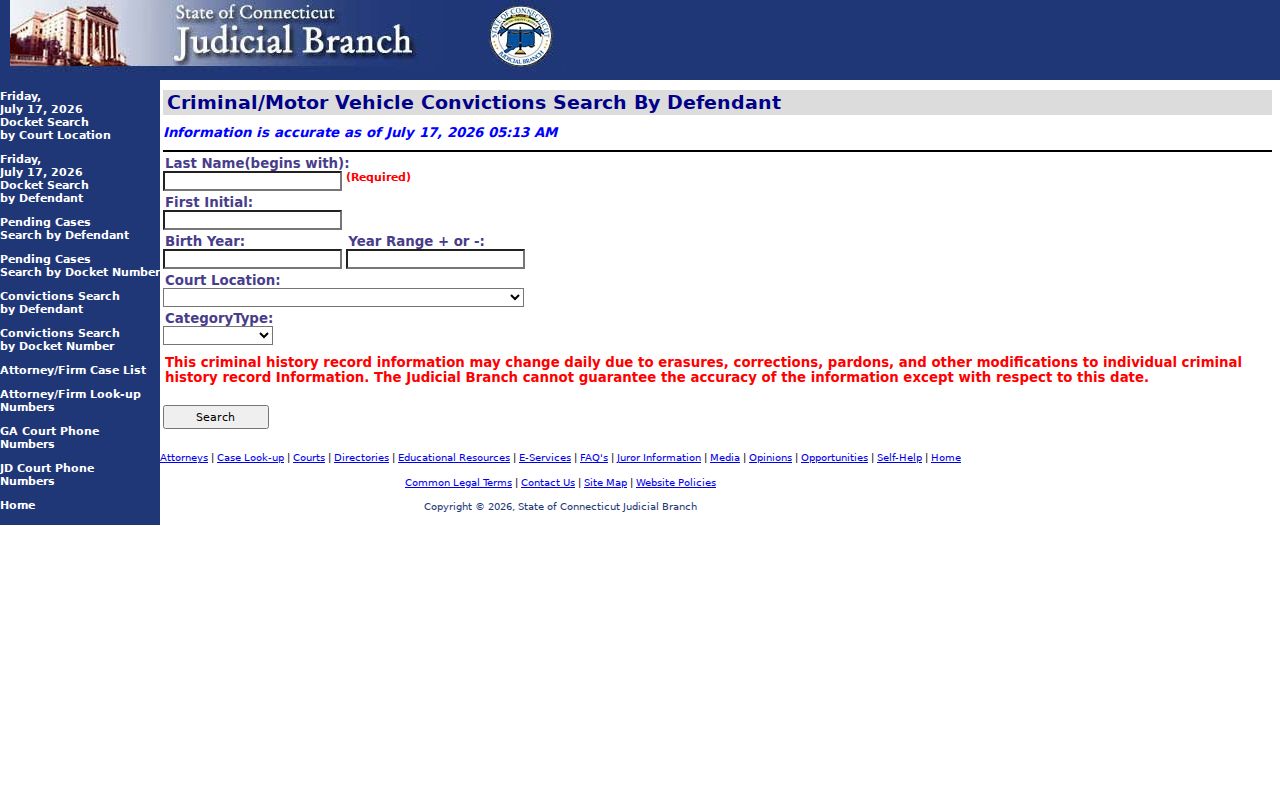
It should not be used as a complete list of arrests or every old case.
Connecticut's criminal record erasure statute explains why some results lawfully vanish.
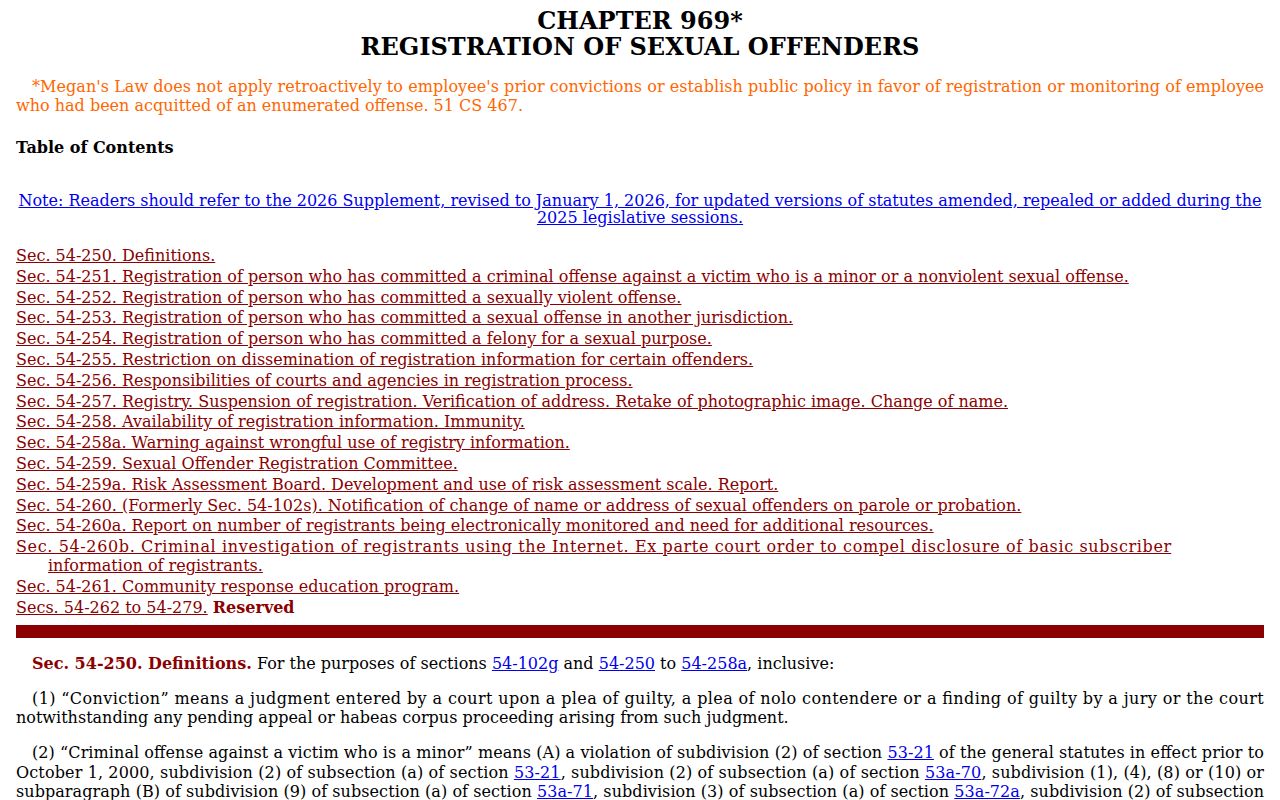
Dismissals, not-guilty outcomes, qualifying nolles, pardons, and Clean Slate relief can restrict later access.
Case Record Access & Restrictions
Connecticut court records begin with a presumption of public access, but that rule has firm limits. Juvenile and Youthful Offender matters are protected. Erased cases are treated as though the proceedings did not occur for public-record purposes. Sealing orders, victim privacy rules, and redaction duties can also remove names, addresses, exhibits, or whole files from public view.
For a public file that exists, request the precise document rather than “everything.” Give the docket number and document date. Ask about plain versus certified copies before ordering. If access is denied, request the legal basis and ask whether a redacted copy can be released.
The right correction path depends on which office made the entry. Ask the GA 7 clerk about a wrong docket event, charge disposition, sentence, or party identifier in the judicial file. A mistake in the underlying police report goes to Meriden Police instead. When the questioned information appears in a Connecticut criminal-history response, identify the agency that contributed the arrest or disposition and use the State Police Bureau of Identification process. Save the docket or incident number, the portal's accuracy timestamp, the office response, and a dated copy of the disputed entry. Those details separate a source error from an outside copy that simply has not updated.
Erasure can explain a changed search result. Under §54-142a, a final not-guilty result or dismissal is erased after the appeal period or final appeal. A nolle ordinarily reaches erasure after thirteen months. An Absolute Pardon and qualifying Clean Slate relief can also remove public access. Offense date and statutory exclusions matter, so a case's class letter alone does not establish Clean Slate eligibility. Once relief is granted, verify both the Judicial Branch result and a current SPBI history rather than assuming every outside copy changed at the same time.
Federal cases follow another route. Meriden lies within the U.S. District Court for the District of Connecticut. A federal charge appears through PACER and the federal clerk, not merely because a person searches the Connecticut criminal portal. Likewise, an appeal produces an appellate file distinct from the GA 7 trial docket. Search the court system that actually created the record before treating an empty local result as conclusive.
Note: Court records show judicial action; they do not prove every statement in an arrest or incident report.